 CodeBrisk
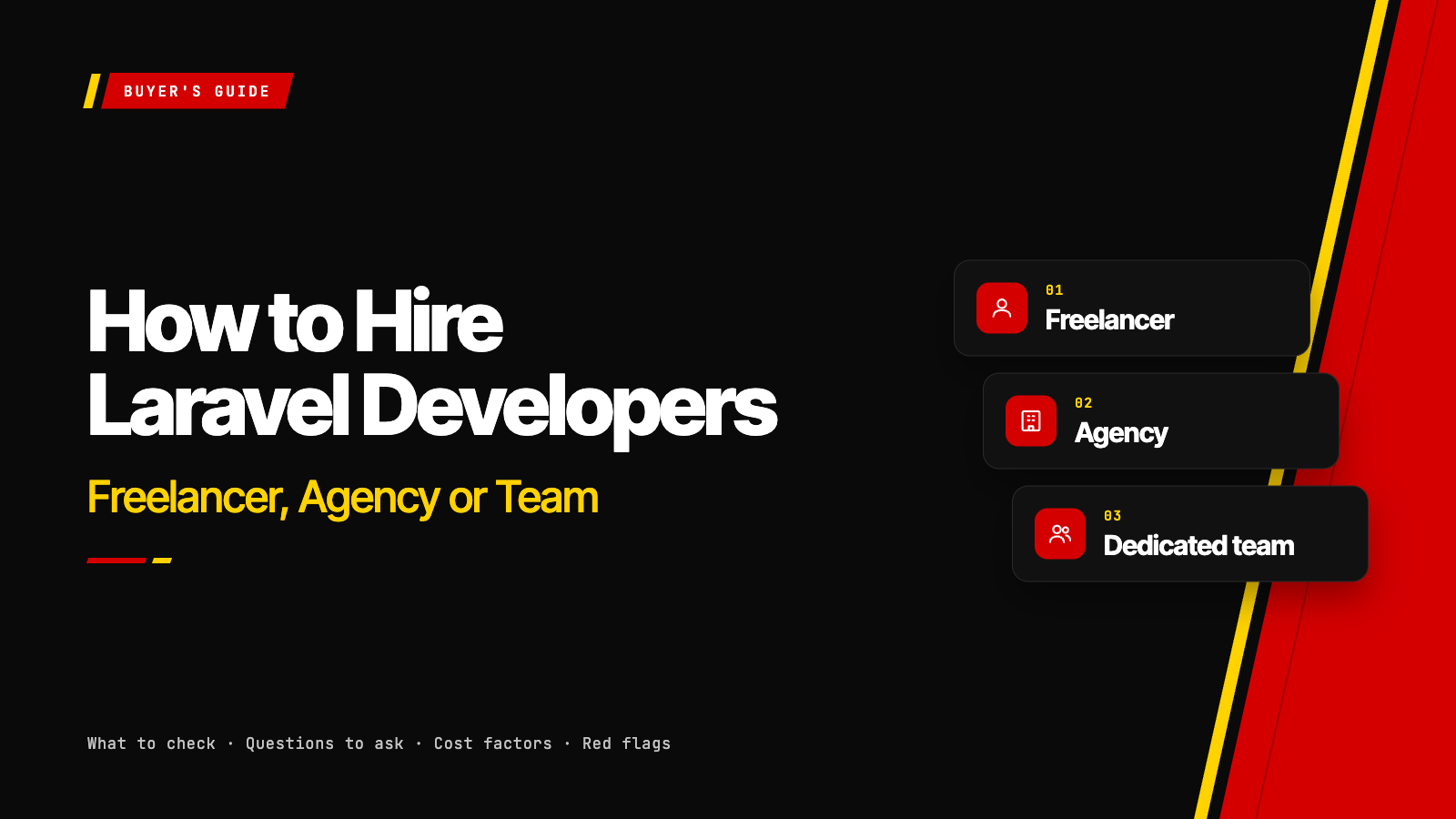
You have a Laravel product to build, rescue or keep running, and you need developers you can trust with it. The hard part isn't finding Laravel developers. There are thousands. It's telling the good ones from the rest before you have paid for six months of code you can't maintain.
This guide is for founders, CTOs and product owners who are about to hire Laravel developers. It compares the three common ways to hire (freelancer, agency, dedicated developer), lists what to check and which questions to ask, explains what drives the cost, and ends with a low-risk way to start.
Freelancer, agency or dedicated developer: which should you hire?
There is no single right answer. The best model depends on how well defined the work is and how long it will last.
| Freelancer | Agency (project team) | Dedicated developer | |
|---|---|---|---|
| Best for | Small, well-defined tasks | A whole product built end to end | Ongoing work on your product |
| Who manages the work | You | The agency | You, with support from the developer's team |
| Continuity | Depends on one person | High; the team covers holidays and turnover | High, if the developer is backed by a team |
| Skills covered | One person's skills | Back end, front end, design, QA | One main developer plus team support when needed |
| Cost structure | Usually the lowest hourly rate | Higher, includes management and QA | Hourly or monthly, between the two |
| Main risk | Single point of failure | Layers of people between you and the code | You still need someone who sets priorities |
Hire a freelancer when the task is small and clear: a bug fix, a payment gateway integration, a one-off performance problem. Good freelancers are excellent at this. The risk shows up when the work becomes long-term and everything depends on one person's availability.
Hire an agency when you need a complete product and don't have a technical lead: discovery, design, development, testing and launch, with someone accountable for delivery. Ask who will actually write the code and whether you can talk to them directly. Too many layers between you and the developers slow everything down.
Hire a dedicated developer when you have a product that keeps evolving: new features every month, maintenance, integrations. You get one developer who learns your codebase and business, and works in your tools. If that developer comes from a team, you also get cover for holidays and access to other skills (front end, mobile, DevOps) without hiring each one.
Many products move between these models over time. They start with an agency to build the first version, then keep one or two dedicated developers from the same team for the ongoing work.
What to check before you hire Laravel developers
A CV that lists "Laravel, Vue.js, MySQL" tells you very little. These checks tell you much more.
1. Real code, not just a portfolio
Screenshots show what was built, not how. Ask for a code sample, a public repository, or a short walkthrough of a real project's structure. Look for:
- Business logic in clear places (actions, services, jobs), not 500-line controllers.
- Form requests or validators for input, policies or gates for authorization.
- Database migrations that tell a coherent story, with indexes on the columns used for lookups.
- Tests. Even a few feature tests for critical flows are a good sign.
If you are not technical yourself, ask a trusted developer to spend an hour reviewing it. That hour is the cheapest insurance you will buy.
2. Knowledge of Laravel versions and upgrades
Laravel ships a major version every year. Each release gets bug fixes for 18 months and security fixes for 2 years, according to Laravel's support policy. A good Laravel developer knows which version your app runs, when it stops receiving security fixes, and what the upgrade path looks like.
Ask: "Our app runs Laravel X. What would you check before upgrading it to the latest version?" A strong answer mentions the official upgrade guide, test coverage, outdated packages and the PHP version on the server. If your app is already behind, see our Laravel upgrade and migration service and the post on migrating legacy applications to Laravel.
3. How they test and deploy
Ask how a change goes from their laptop to production. You want to hear about version control (Git, pull requests), automated tests, a staging environment, and a repeatable deployment, not "I upload the files over FTP".
4. Communication
Most outsourced projects that fail do so because of communication, not code. Check:
- How quickly and clearly they answer your messages during the hiring process. It won't get better after you sign.
- Whether they ask questions about your business, not just the features.
- Whether they put estimates, assumptions and risks in writing.
- How many hours their working day overlaps with yours, and when you will meet.
5. Ownership and access
Before any work starts, agree that you own the code, the repository, the hosting accounts and the domain. The developer gets access to your accounts, not the other way round. Ask for an NDA if your idea or data is sensitive.
Questions to ask a Laravel developer or agency
Use these in your first call. Listen for specific answers based on real projects.
- "Tell me about a Laravel project you have maintained for more than a year." Long-running projects show that a developer writes code they can live with.
- "How would you structure [your main feature]?" You are not looking for a perfect answer, but for clear thinking, questions back to you and awareness of trade-offs.
- "What do you do when a third-party API is slow or down?" Good answers mention queued jobs, retries, timeouts and logging. This matters for any app that talks to payment gateways, accounting software or other services (see API development and integration).
- "How do you handle a bug in production?" Look for error monitoring, a way to reproduce it, a test that proves the fix, and communication with you along the way.
- "Who will actually write the code, and can I talk to them?" Especially important with agencies.
- "What happens if you are unavailable for two weeks?" A freelancer should have an answer; a team should have a simple one.
- "How do you estimate, and what happens when an estimate is wrong?" Honest developers explain their assumptions and tell you early when scope changes.
What drives the cost of hiring Laravel developers
You will find many rate tables online, and they contradict each other because most come from companies selling a particular model. Instead of a number, look at what actually moves the price:
- Experience. A senior developer costs more per hour and usually less per feature, because they make fewer wrong turns and leave less to fix later.
- Scope clarity. A clear, written scope can be quoted at a fixed price. Unclear or changing scope is fairer to everyone on an hourly basis.
- What's included. Project management, QA, design and DevOps are either in the price or your responsibility. Compare like with like.
- Location and overlap. Rates vary a lot by country. Paying less for a team in another time zone works well when there is a few hours' overlap and clear written communication.
- The state of the existing code. Taking over an old, untested application takes more time at the start. A good developer will say so and suggest a review first.
- Long-term maintenance. Launch is not the end. Budget for security updates, bug fixes and improvements every month (we explain why in the importance of Laravel maintenance and support).
The cheapest hourly rate is rarely the cheapest project. Rewriting code that was built quickly and badly often costs more than building it properly the first time.
Red flags when hiring Laravel developers
- They agree to everything immediately, with no questions and no concerns.
- They promise a fixed price and deadline for a vague idea.
- They want to host the code or the app in their accounts.
- They can't show any code, or won't explain past projects in detail.
- They have no answer to "how do you test this?"
- Every developer you talk to at an agency is a salesperson, never an engineer.
- Their own website is slow, broken or years out of date.
None of these alone is a deal-breaker, but two or three together usually are. For more on what good Laravel work looks like, see our dos and don'ts of Laravel web application development.
How to start with low risk
You don't need to commit to a year-long contract to find out whether a developer is right for you.
- Write a one-page brief. What the product does, who uses it, what exists today, the most important next feature and any deadlines.
- Hold a call with two or three candidates. Use the questions above. Notice who asks the best questions back.
- Start with a small paid task. A real feature or bug fix that takes a few days. You see their code, their communication and how they estimate, on your codebase.
- Give access to your own accounts. Repository, issue tracker, staging server. Keep production access limited at first.
- Agree how you will work. Weekly check-ins, how tasks are written and prioritized, and how time is reported.
- Review after a few weeks. If the work and communication are good, extend the engagement or add more developers from the same team.
How CodeBrisk works with clients
We are a Laravel web and mobile app development company founded in 2014. Clients hire us as a dedicated developer inside their team or as a full team that owns delivery, hourly or at a fixed price. On Upwork we are a Top Rated agency with 100% Job Success, $600K+ earned and 31,300+ hours over 87 jobs. Several clients have worked with us for many years, on products like the ones in our transportation management system and deduction management system case studies.
If you are looking to hire Laravel developers, see how we work on our Hire Laravel Developers page, or tell us about your product on Launch your project. We'll reply with how we would approach it.

Rizwan Aslam
Founder and CEO of CodeBrisk, with years of experience building web applications with Laravel and leading a team of expert developers.
More about Rizwan