

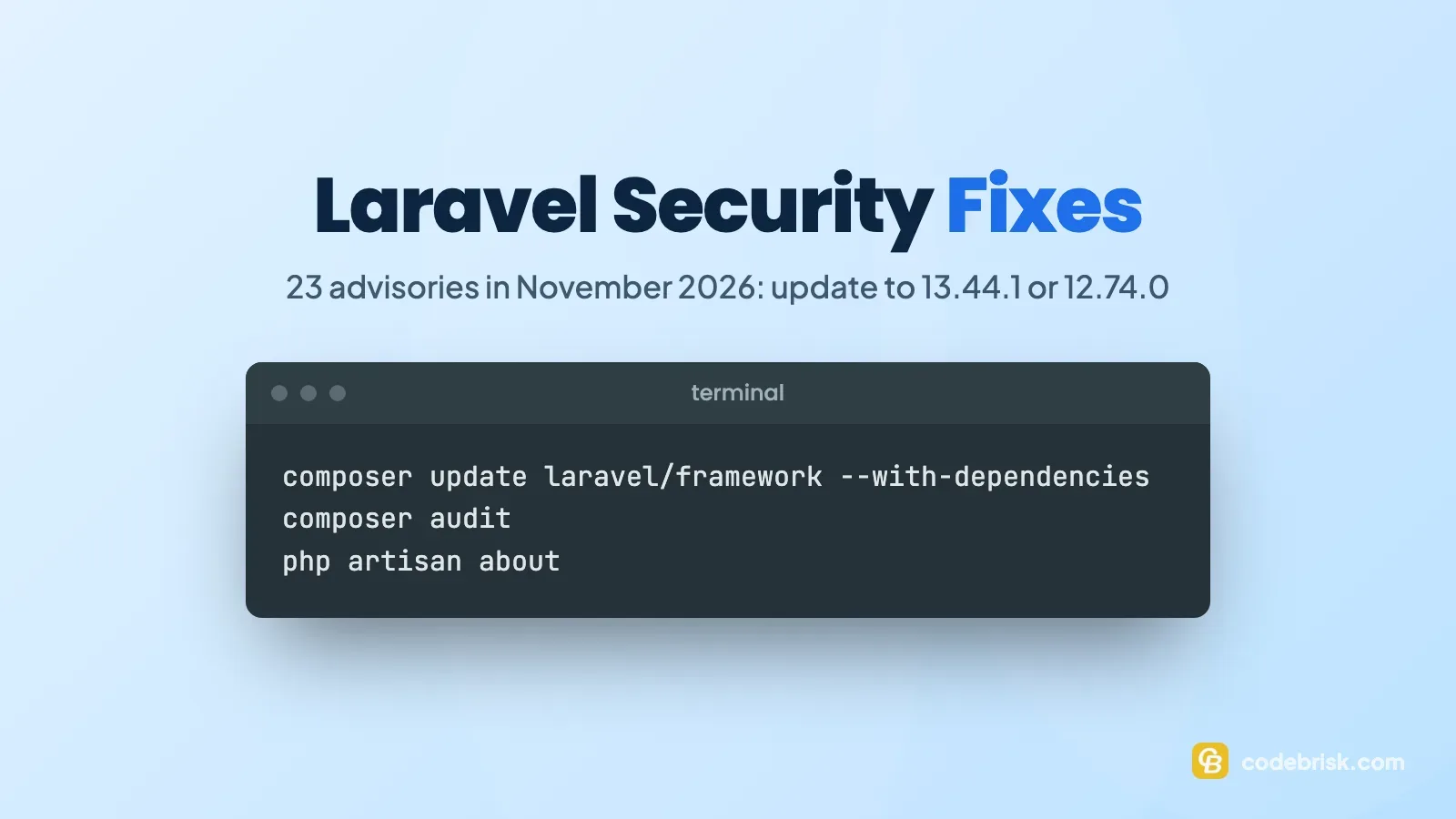
In November 2026 the Laravel team published 23 security advisories for the framework: 2 rated high, 18 medium and 3 low (GitHub advisories). They arrived in the same weeks as PHP's critical security release, so many Laravel apps now need two updates, not one.
The short answer for app owners: update to Laravel 13.44.1 or 12.74.0. Those two versions include every fix. If your app runs Laravel 11 or older, there is no patch to install, and that is the bigger problem.
We applied this update to codebrisk.com this week. This guide explains what was fixed in plain language, which apps are most exposed, and how to update without breaking anything.
Which versions fix the November Laravel advisories?
| Your Laravel version | Update to | Notes |
|---|---|---|
| 13.x | 13.44.1 or newer | The last fix (numeric validation) only landed in 13.44.1 |
| 12.x | 12.74.0 or newer | Laravel 12 gets security fixes until 24 February 2027 |
| 11.x or older | No patch | No longer supported; plan an upgrade (support policy) |
The advisories only list Laravel 12 and 13, because older versions are no longer maintained. That doesn't mean Laravel 10 or 11 are safe. It means nobody checks or fixes them anymore.
How do you check which Laravel version you run?
Run these on the server (or ask your developer to):
php artisan about
composer show laravel/framework
composer audit
php artisan about shows the Laravel and PHP versions. composer audit compares every installed package against the public advisory database and lists anything with a known vulnerability, not only Laravel itself. When we ran it on our own site after updating the framework, it still flagged two other packages (used for passkey sign-in), which we updated in the same change. That is common: the framework is only one part of your dependencies.
What was fixed, in plain language
You don't need to read all 23 advisories. They fall into a few groups, and each group matters for a different kind of app.
1. Requests that can take your app offline (the two high ones)
- Crafted JSON bodies (GHSA-8h64-cpq2-9h2g, high): a JSON request of ordinary size could make Laravel use far too much CPU and memory. An unauthenticated attacker sending a handful at once could use up every PHP worker. Fixed in 13.38.0 and 12.74.0.
- Extreme numbers in validation (GHSA-c25c-x5r7-2v5m, high): the
multiple_ofrule, andgt,gte,ltandltewhen they compare two fields, could be fed a number like1e999999and exhaust memory. Fixed in 13.44.1 and 12.74.0.
Medium-rated issues in the same group affect the email rule with oversized international domains and the decimal rule with very long numbers. Any app with a public form or API, which is nearly every app, should treat these as urgent. They don't leak data, but an outage during business hours costs real money.
2. Validation that could be skipped
Validation is how your app decides what input to trust. Several advisories found ways to slip past it:
- Array items with an empty key skipped their
items.*rules. - Nested fields using
sometimeswere skipped when the value was the literal text__missing__. - On MySQL and MariaDB, the
existsanduniquerules could be satisfied by JSON values like0orfalseon text columns, so "this invite code must exist" checks could pass without a valid code. Rule::exists()andRule::unique()scoped withwhere()could treat values such asNULLor!…as conditions instead of plain values. For multi-tenant apps that use these rules to check that a record belongs to the current customer, this could accept another customer's record.- The
inrule compared values loosely, so inputs that weren't in the allowed list could pass.
If your app is a SaaS, a portal or anything with several customers in one database, this group deserves the closest look. Our guide to Laravel multi-tenancy explains why tenant checks must never rely on a single layer.
3. Privileges and uploads
- Mass assignment (GHSA-6pxv-c29g-cc5h): a model protected with
$guardedcould still have a guarded field (such as a role oris_adminflag) written through an alternate spelling of its name, if the field also has a mutator and the code saves$request->all(). - File uploads: an empty text field with the same name as an upload could hide the file from validation, so type and size checks were skipped while the file was still stored.
4. Cross-site scripting in Blade components
Two issues let user-controlled values break out of HTML attributes in Blade components (dynamic components and attribute bags with Stringable values). That allows script injection in the browser of whoever views the page, for example an admin reviewing a customer's input.
5. Signed links, proxies and logins
- Signed URLs: two advisories allowed an expired temporary signed URL to keep working under certain conditions. Apps use these for downloads, invitations and email links.
- Fake IP addresses: on apps with no trusted proxies configured, a visitor-controlled header could make Laravel believe the request came through a Forge or Vapor proxy. That can get around IP-based rate limits such as login throttling.
- Sanctum on Laravel 12: in a specific eager-loading setup, the API guard could return the lowest-ID user (often an administrator) instead of the token's owner. Fixed in 12.73.0.
The full list also covers PostgreSQL JSON path escaping, storage signed URLs, broadcasting, concurrency output and Markdown mail. If you run any of those features, read those advisories in full.
How to update safely
These are patch releases within the same major version, so the update is usually small. "Usually" is why you still test it:
- Update the framework and what it needs, nothing else:
composer update laravel/framework --with-dependencies
composer audit
- Fix anything
composer auditstill reports in the same change, then run it again until it is clean. - Run your test suite. If you have no automated tests, check the critical paths by hand: sign-in, payments, your main forms, file uploads, the admin panel and scheduled jobs.
- Deploy to staging first, then production, with a way to roll back (the previous release or the previous
composer.lock). - Patch PHP too. The November PHP release is a separate update to the server, not to your code.
Can't update today? Reduce the risk
If a release has to wait, a few changes lower the exposure:
- Put bounds in front of numeric rules:
bail|numeric|min:0|max:100|multiple_of:5instead ofmultiple_of:5alone. - Add
max:lengths to text and email fields on public forms. - Save validated data (
$request->validated()), never$request->all(). - Configure trusted proxies explicitly if your app sits behind a load balancer or CDN.
- Rate limit public endpoints and watch for spikes in slow requests.
These are good habits anyway, but they are not a replacement for the update.
What if you're on Laravel 11 or older?
Then this month is a clear signal. You're running a framework that no longer gets security fixes, and the list of known, public issues grows every month. Version upgrades are much easier one major at a time. The longer they wait, the more packages and PHP versions change underneath. PHP 8.2, a common pair for older Laravel apps, also loses support on 31 December 2026 (see our PHP 8.2 end of life guide).
A Laravel security audit is a good first step: it shows what you're running, what's exposed and what to fix first.
Make this routine, not a scramble
November was unusually busy, but security releases are now a monthly event for PHP and Laravel apps. The teams that handle them calmly have three things in place: composer audit running in their deployment pipeline, a test suite that makes updates safe, and someone responsible for watching advisories. Our Laravel maintenance checklist covers the full routine.
Get your Laravel app patched
CodeBrisk was founded in 2014 and has worked with Laravel since 2015, with a 100% Job Success score as a Top Rated agency on Upwork. Through our Laravel maintenance and support service we apply updates like these, test them and keep your app current. If your app is on an unsupported version, our upgrade and migration service takes it to a supported one step by step.
Contact us with your Laravel and PHP versions, and we'll tell you what your app needs.

Rizwan Aslam
Founder and CEO of CodeBrisk, with years of experience building web applications with Laravel and leading a team of expert developers.
More about Rizwan